

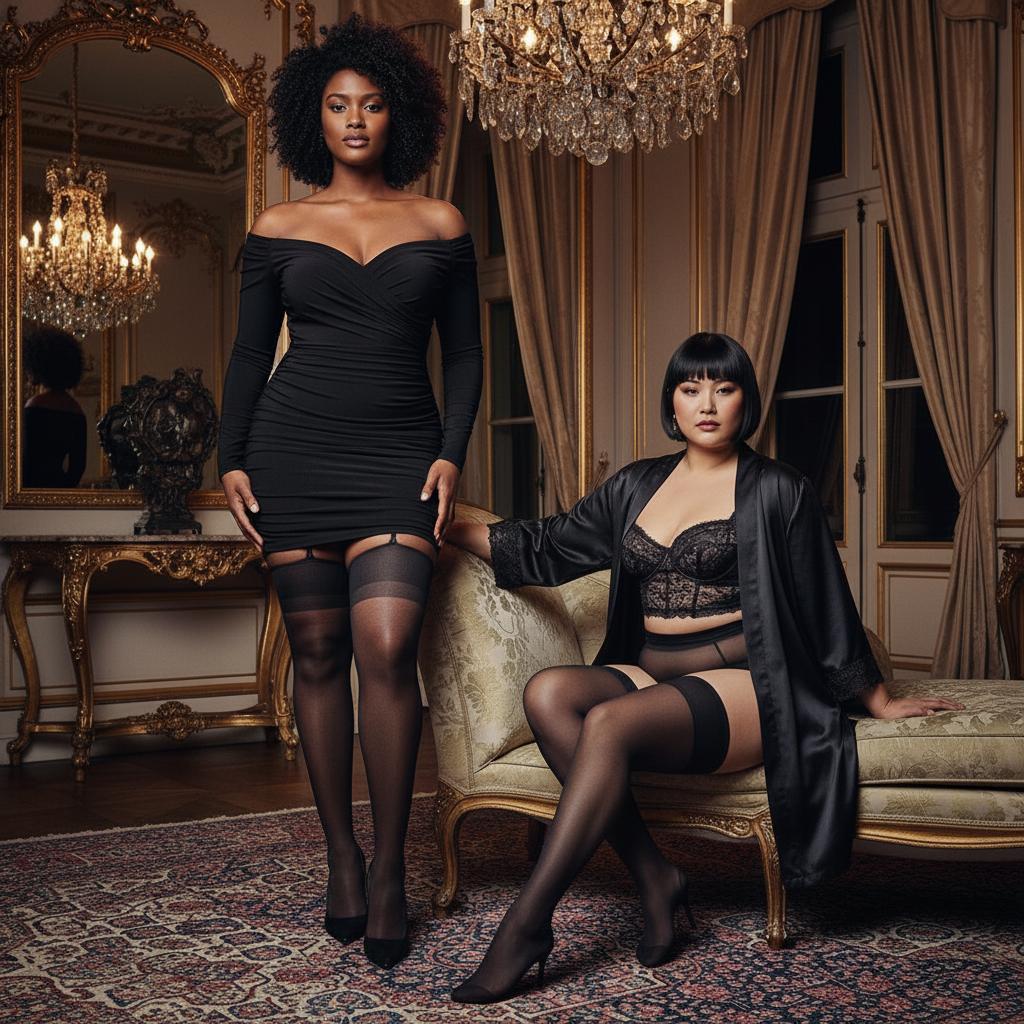
Join us on a journey through the history of tights! Today we're looking at a garment we often take for granted, but which has gone through one of the most exciting developments in fashion history. We're talking about the accessory that keeps us warm, shapes us and completes our outfits: tights. Whether you love them or (on bad days) battle with them, their history is full of surprises, revolutions and a touch of scandal.
From a male status symbol in the Middle Ages to a high-tech marvel for curvy women today: we show you how tights conquered the world.
1. The history of tights – the beginning: when tights were for men
When we think of tights today, we picture women's legs. But that wasn't always the case. In early history and the Middle Ages, it was mainly men who showed off their legs. The forerunners back then were known as "hose" – separate tubes of fabric or leather attached to a belt.
Over the centuries, especially during the Renaissance, these hose became more close-fitting and developed into a kind of trouser that showed off shapely calves. They were a sign of wealth, power and masculinity. Famous rulers such as Henry VIII or the "Sun King" Louis XIV strutted proudly in silk stockings. For women, legs were taboo at the time – they disappeared under floor-length skirts.
2. The Industrial Revolution: stockings for everyone
Until the 19th century, fine stockings were a luxury product. That changed with the invention of the mechanical knitting frame. Suddenly, legwear could be produced faster and more cheaply. Cotton and wool made stockings affordable for the masses. But one problem remained: the fit. Without elastic fibres, stockings quickly went baggy at the knees and had to be held up with fiddly garters.
3. 1935: the nylon revolution
Probably the biggest turning point in the history of materials took place in the laboratories of the DuPont company. Chemist Wallace Carothers invented a "miracle fibre" that was said to be as fine as a spider's web yet as strong as steel: nylon.
When the first nylon stockings went on sale in the USA in 1940, there were scenes of near-riot. Women queued for hours to get their hands on a pair of these tear-resistant, sheer stockings. Nylon was the first step into the modern age – although at the time, women still wore individual stockings with suspenders, not tights.
4. 1959 & the 60s: the birth of real tights
When did two stockings become tights? Tights as we know them (called pantyhose in the US) are younger than many people think. In 1959, Allen Gant Sr. developed "Panti-Legs" – a combination of knickers and stockings. But why did they catch on?
The reason was a fashion scandal: the miniskirt.
In the swinging 60s, designer Mary Quant made skirts shorter than ever before. Suddenly suspenders and stocking tops were on show – an absolute no-go. The solution was the new tights. They covered the leg right up to the waist and made the triumph of the miniskirt possible in the first place. If you'd like to know more about this wild era and the invention of synthetic fibres, you'll find fascinating background on the history of polyamides and nylon on Wikipedia.
5. Elastane: the road to comfort
While the tights of the 60s and 70s were practical, they were often still stiff and shiny. The introduction of elastane (Lycra) in the 80s brought the next leap forward. At last, the material adapted to the body instead of just lying on top of it.
But this is also where a new problem began, one that many of our customers know only too well: standardisation. The fashion industry set "standard sizes" that often stopped at size 40 or 42. Curvy women had to squeeze into waistbands that were too tight or settle for unflattering "granny styles".
6. The modern era: Glamory and the perfect plus size fit
And this is where we come in. For a long time, the history of tights was a history of "one size fits all" – which was usually a lie. At Glamory, we have rewritten this chapter.
We know that a size 50 isn't simply a size 38 "stretched wider". A curvy body needs:
- More room at the thigh: so that nothing chafes.
- Higher waistbands: so that nothing slips or digs in.
- Cotton gusset and extra-roomy brief section: for freedom of movement.
Today, tights are a high-tech product. Whether you're looking for supportive Vital tights for long days at the office or a seductive fishnet style for the evening – the days of slipping, scratchy woollen stockings are over.
A look into the future
The journey isn't over yet. We are constantly working on even softer yarns, more sustainable materials and fits that feel like a second skin. Tights have evolved from a knight's legwear into women's most important accessory – and we'll make sure they keep showing off your curves perfectly in the future too.